
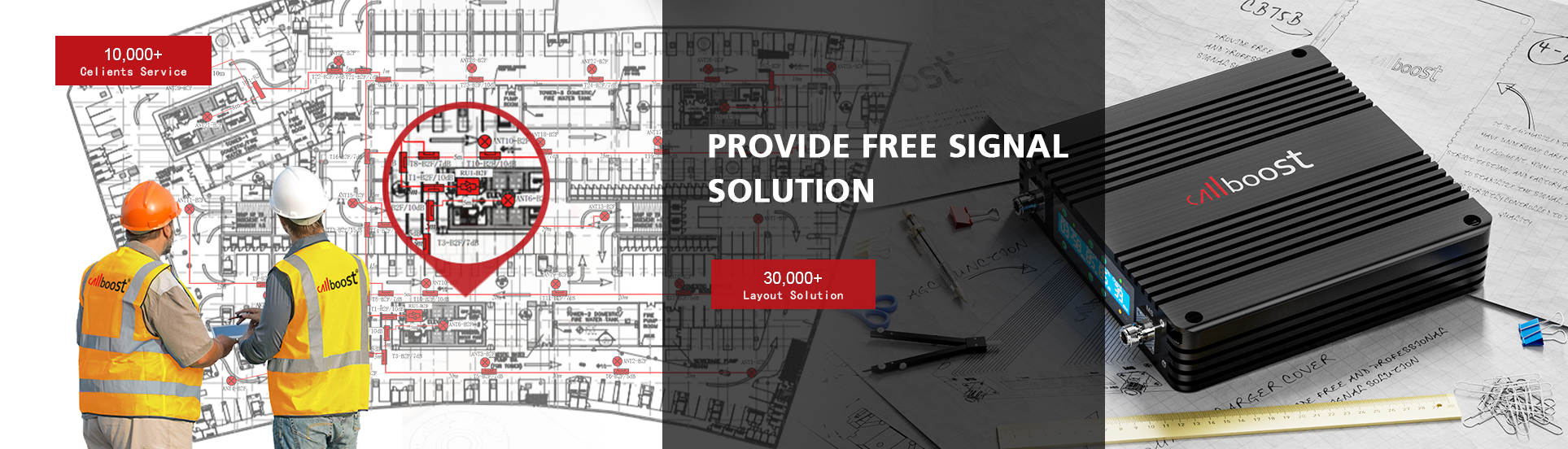
Choosing a mobile signal booster is not only about coverage area or price. A reliable 4G or 5G signal booster must match the local mobile network bands, outdoor signal strength, building structure, cable loss, antenna layout and indoor coverage requirements.
Many buyers only compare one number: coverage area. This is a weak way to choose a signal booster. A professional mobile signal booster should be judged by RF performance indicators such as gain, output power, uplink gain, downlink gain, noise figure, AGC, MGC, ALC, isolation detection and uplink sleep function.
A mobile signal booster is also different from a WiFi router or WiFi extender. It improves cellular signals such as 2G, 3G, 4G LTE and 5G. It does not create internet by itself. It receives an available outdoor mobile signal, amplifies it through the repeater, and distributes the improved signal indoors through service antennas.
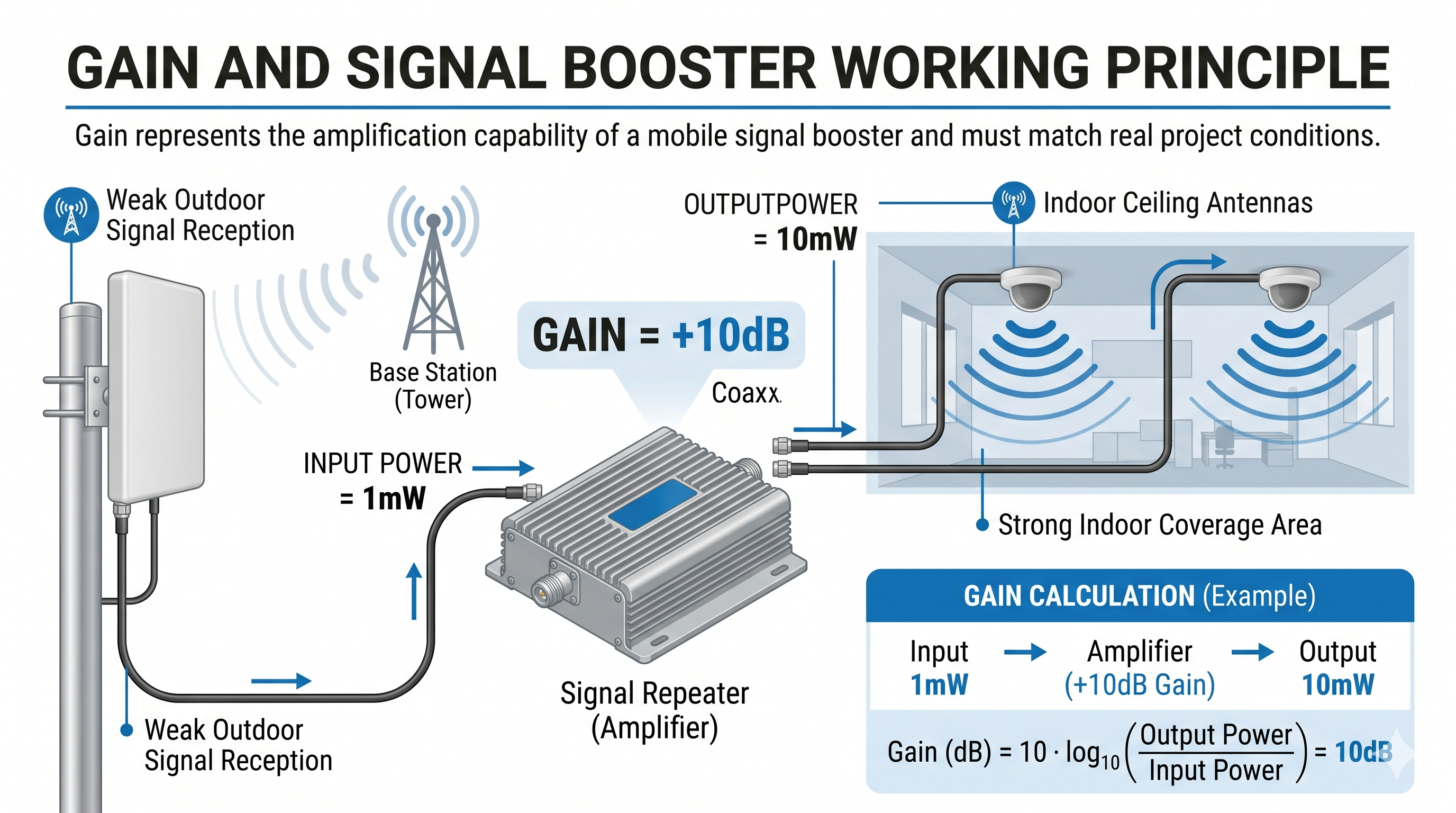
1. Gain: The Basic Amplification Capability
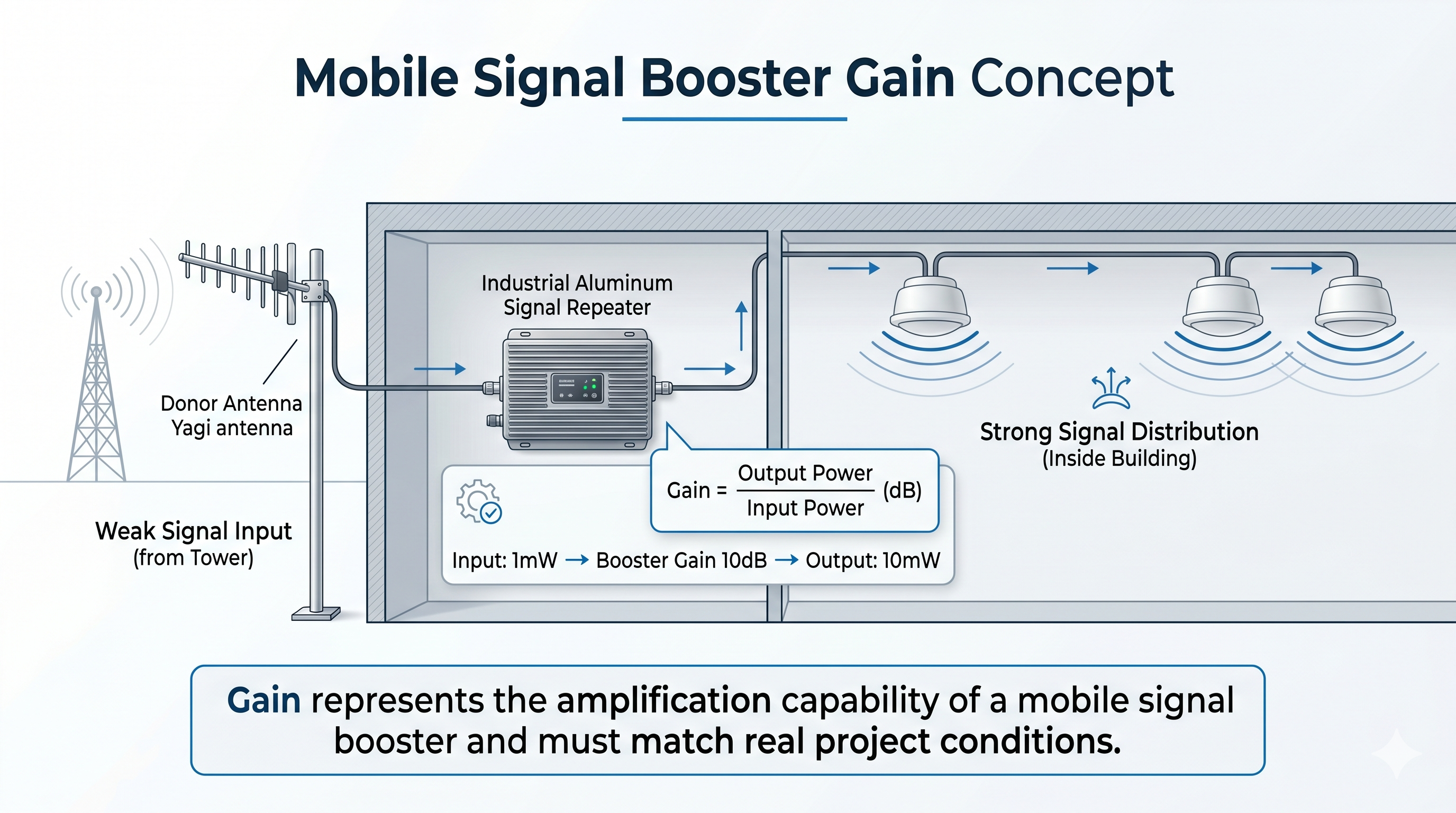
Gain represents the signal amplification capability of a [mobile signal booster].It is usually measured in dB.
For example, if the input signal is 1mW, equal to 0dBm, and the output signal becomes 10mW, equal to 10dBm, the gain is 10dB. This means the signal strength has been amplified by 10 times.
However, higher gain does not always mean better performance. The correct gain depends on outdoor signal strength, frequency band, cable length, cable loss, antenna distance, building wall structure, indoor coverage area and uplink/downlink stability.
For small homes, offices and shops, a 70dB or 75dB signal booster may be enough. For larger buildings, warehouses, hotels, basements or commercial projects, higher-gain and higher-power models may be required.
For example, Callboost 75dB series signal boosters are commonly used for medium indoor coverage projects around 500–1000㎡, depending on the installation environment and antenna layout. For larger engineering projects, Callboost also provides 85dB, 90dB and 95dB signal repeaters.
2. Output Power: The Real Factor Behind Coverage
Output power affects how strongly the booster can transmit the amplified signal indoors. It is usually measured in dBm.
In general, higher output power can support wider indoor signal coverage. But output power must be controlled properly. If the output is too strong or the system is poorly designed, it may cause overload, oscillation or interference to the carrier network.
For example, many Callboost [75dB signal boosters] provide around 27dBm downlink output power and around 17dBm uplink output power, depending on the model and frequency band. This level is suitable for many homes, villas, offices, shops and medium indoor spaces.
For larger projects, higher output power may be needed:
85dB series: larger indoor coverage projects
90dB series: commercial and engineering coverage
95dB series: large-area high-power projects
A real solution must also consider outdoor antenna gain, indoor antenna quantity, cable loss, splitter loss and antenna isolation.
3. Uplink and Downlink Gain
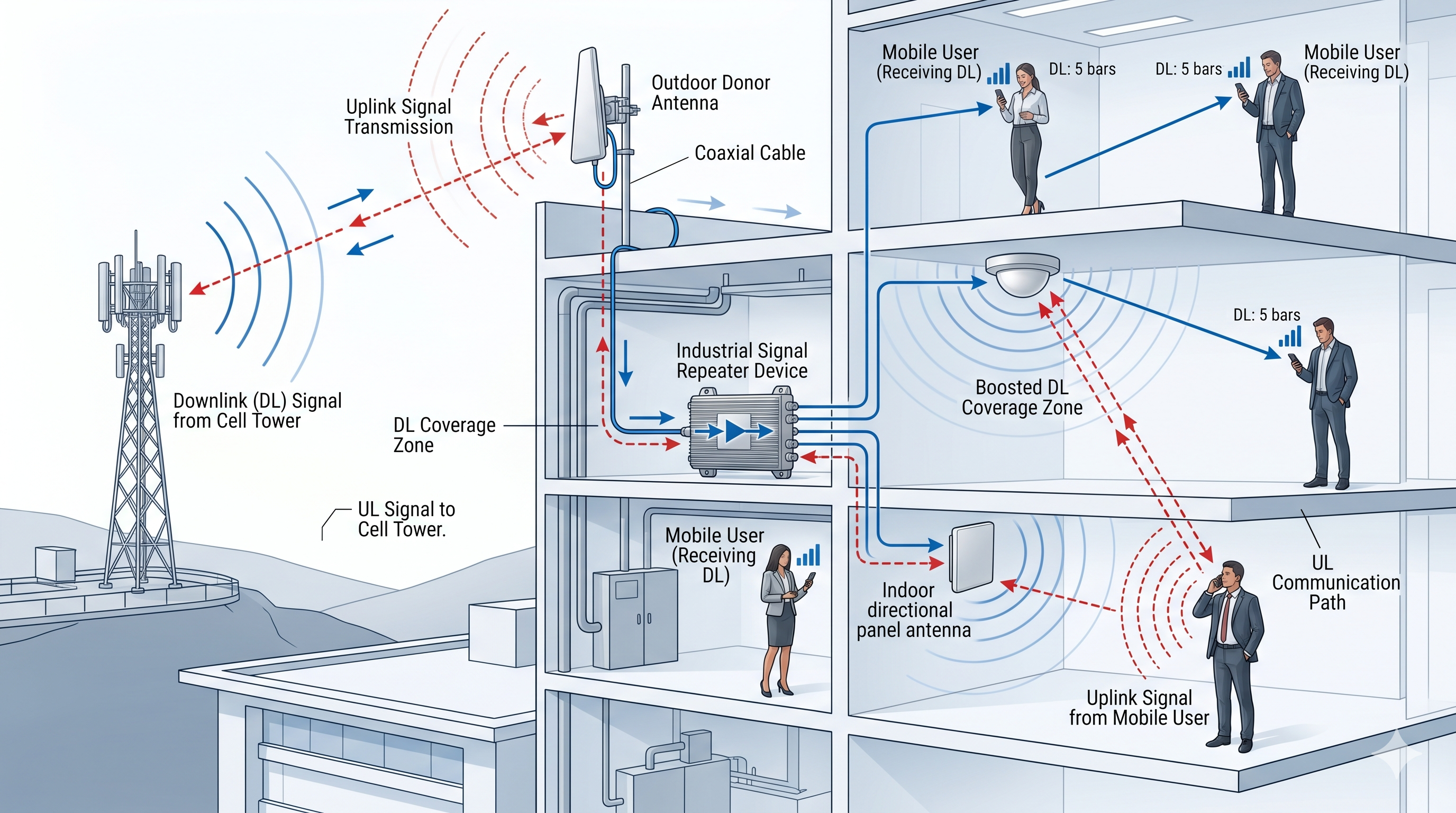
A mobile signal booster works in two directions.
Downlink means the signal from the cell tower to the mobile phone. It affects signal bars and mobile data reception.
Uplink means the signal from the mobile phone back to the cell tower. It affects call quality, upload stability and two-way communication.
Many buyers only check downlink gain. This is a mistake. If uplink performance is poor, the phone may show better signal bars but still have failed calls, unstable uploads or poor voice quality.
A professional booster must balance both uplink and downlink performance.
4. Why Uplink and Downlink Gains Are Different
Uplink and downlink gains are often different because the two communication paths are not equal.
The cell tower transmits a strong downlink signal designed to cover a wide area. A mobile phone has much lower transmit power because it is limited by battery capacity and device size. At the same time, the base station usually has better receiving sensitivity than a mobile phone.
If uplink gain is too high, the booster may create feedback between indoor and outdoor antennas. This can cause self-oscillation, overload or interference to the carrier network.
That is why many Callboost boosters use higher downlink gain and carefully controlled uplink gain. This is not a weakness. It is a stability design.
A good booster should not only increase signal bars. It should deliver a clean, stable and network-friendly signal.
5. AGC, MGC and ALC
A good mobile signal booster should not only amplify the signal. It must also control the signal intelligently.
AGC, or Automatic Gain Control, automatically adjusts the booster gain when the input signal changes. It helps prevent overload, unstable amplification and oscillation.
MGC, or Manual Gain Control, allows installers to fine-tune the system after installation. Many Callboost models support 1dB step adjustment with up to 31dB adjustable range.
ALC, or Automatic Level Control, controls output power and keeps the signal stable. It helps avoid excessive output when the outdoor signal becomes stronger.
These functions are important because real mobile signal conditions change by location, time, network load and operator environment.
6. Antenna Isolation and Self-Oscillation Protection
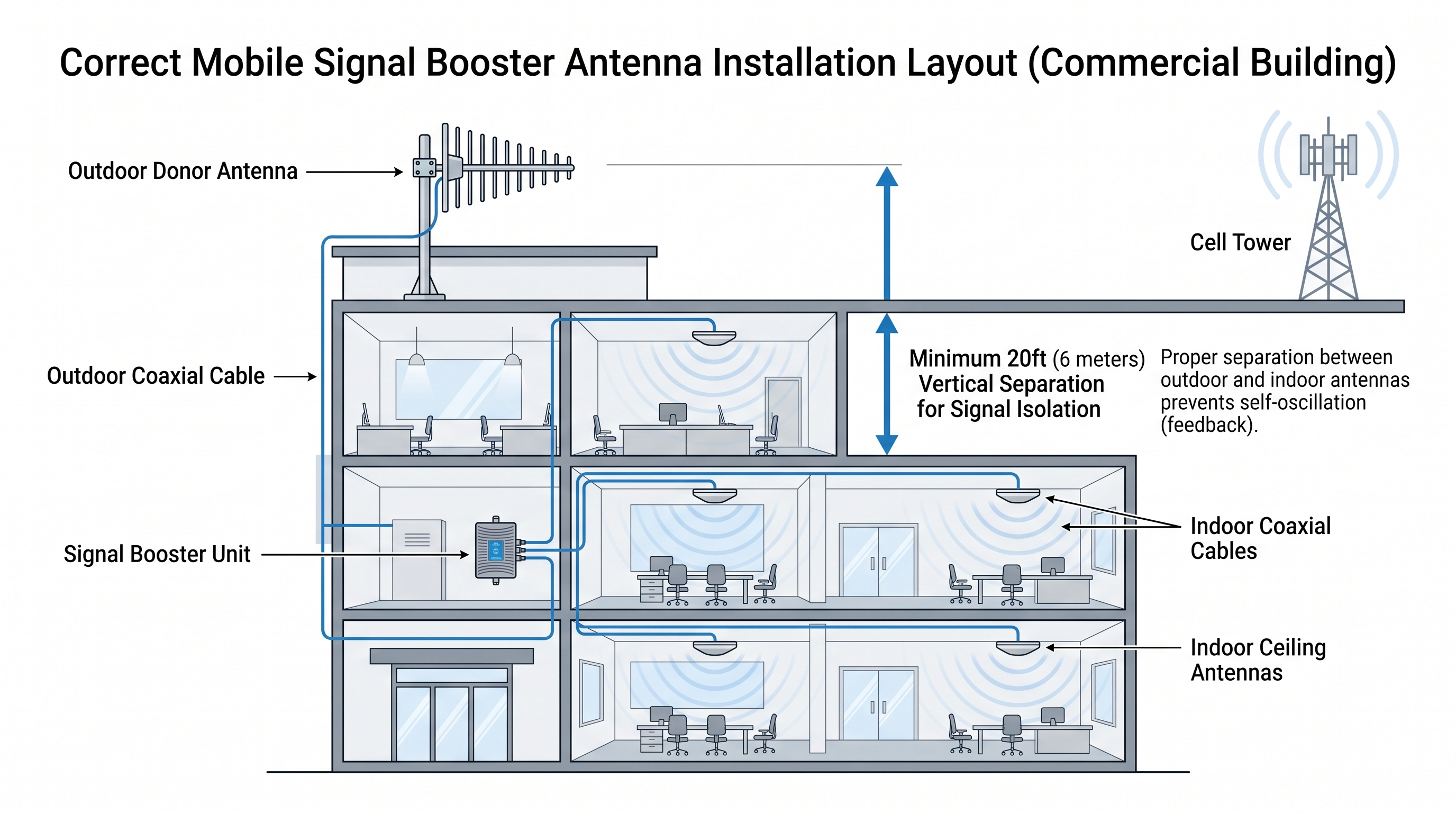
A mobile signal booster system normally includes an [outdoor donor antenna], repeater, coaxial cables, indoor ceiling antennas, panel antennas, splitters, couplers and other [passive components].
If the outdoor antenna and indoor antenna are too close, the indoor signal may be received again by the outdoor antenna. This creates feedback, similar to a microphone placed too close to a speaker. In RF systems, this is called self-oscillation.
Callboost boosters are designed with practical RF protection functions:
Real-time isolation detection
Self-excitation elimination
Automatic gain reduction
Arrêt automatique en cas d'oscillations ou de surcharges importantes
Fonction veille de liaison montante
Conception à faible bruit et à faible rayonnement
Ces fonctions contribuent à améliorer la stabilité du système et à réduire les interférences inutiles avec la station de base.
7. Comment choisir le bon booster Callboost
Différents projets nécessitent différents systèmes d'amplification de signal.
Pour les maisons, les magasins et les petits bureaux, les modèles compacts de 70 dB ou 75 dB sont souvent suffisants.
Pour les villas, les bureaux et les espaces commerciaux de taille moyenne, un amplificateur de 75 dB avec antenne extérieure, antennes intérieures, répartiteur et câblage approprié est généralement plus adapté.
Pour les entrepôts, les hôtels, les usines, les centres commerciaux et les parkings souterrains, le système peut nécessiter des répéteurs d'ingénierie de 85 dB, 90 dB ou 95 dB, plusieurs antennes intérieures et des câbles à faibles pertes.
Pour les grands bâtiments, les tunnels, les sites isolés ou les projets de couverture longue distance, un[répéteur de signal à fibre optique]C'est peut-être un meilleur choix.
8. Quelles informations devez-vous fournir avant d'acheter ?
Avant de choisir un amplificateur de signal mobile, veuillez vérifier :
Pays et ville
opérateur mobile
Réseau requis : 2G, 3G, 4G ou 5G
Bande de fréquence
force du signal extérieur
Type et dimensions du bâtiment
Zone de couverture
Nombre d'étages
Distance du câble
quantité d'antennes intérieures
Callboost peut vous aider à fournir une solution de couverture de signal adaptée aux conditions réelles de votre projet.
Pourquoi choisir Callboost ?
Callboost est un fabricant d'amplificateurs de signal mobile et un fournisseur de solutions de signal personnalisées. Nos produits incluent des amplificateurs de signal 4G,[Amplificateurs de signal 5G], amplificateurs d'intérieur 70dB/75dB, répéteurs d'ingénierie 85dB/90dB/95dB, répéteurs à fibre optique, antennes, câbles, répartiteurs, coupleurs et autres accessoires RF.
Avec AGC, ALC, MGC, détection d'isolation en temps réel, élimination de l'auto-excitation, protection contre l'arrêt automatique et fonction de veille de liaison montante, les amplificateurs Callboost sont conçus pour une couverture de signal mobile intérieure stable et pratique.
Contactez Callboost pour confirmer votre bande de fréquence, votre zone de couverture et les exigences de votre projet avant de choisir le système de répéteur adapté.